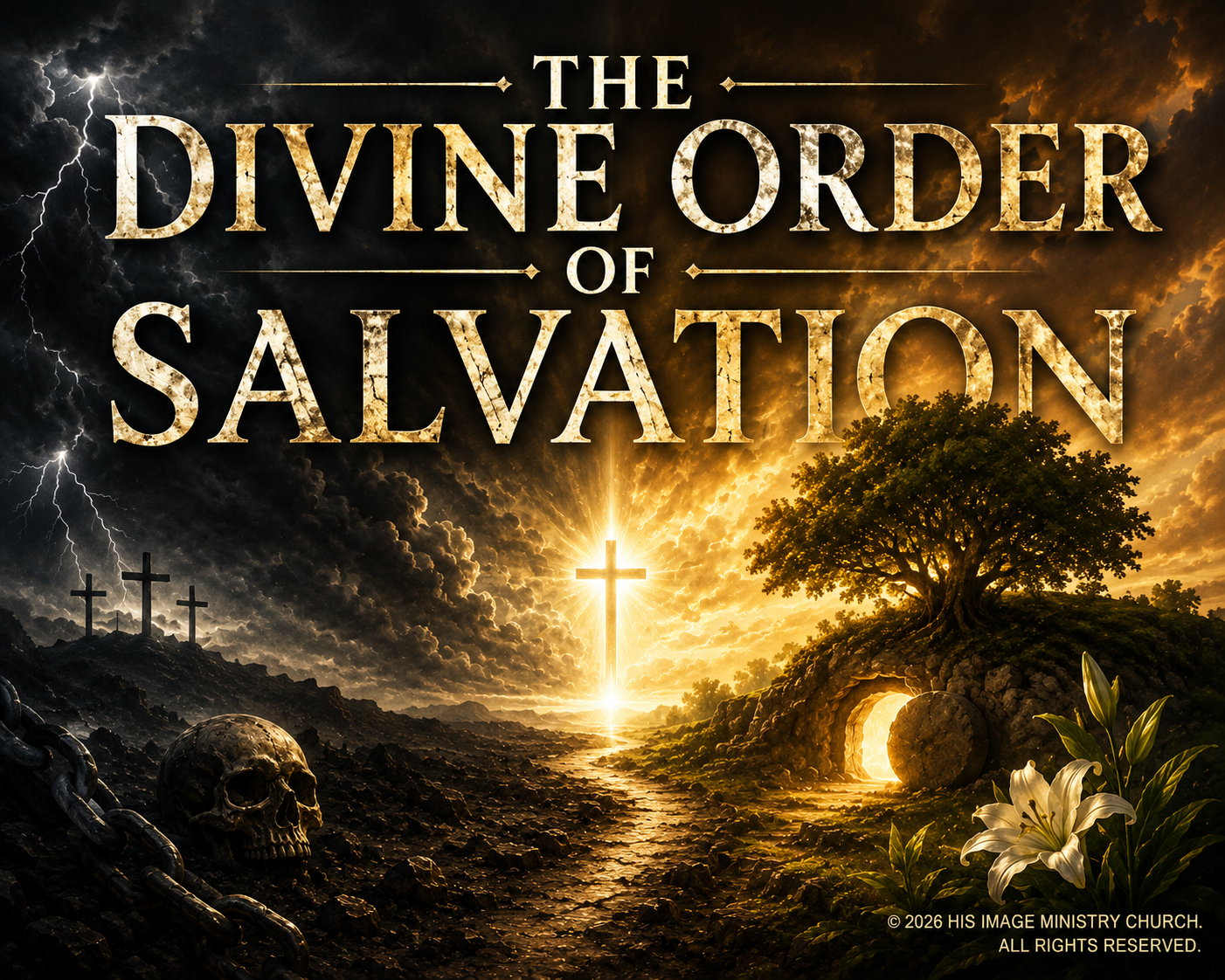
Conciliation, Reconciliation, and the Triumph of Life
By George Maitland of His Image Ministry Church
God does not work through disorder. His purpose does not emerge through human improvisation, religious negotiation, or the uncertain cooperation of the creature. Everything begins in Him, proceeds through Him, and returns to Him. His Word is not merely information about what He hopes will happen. His Word is His singular, original, and immutable will and intention, progressively expressed until everything He has purposed reaches its appointed fulfillment.
This is why the order of God matters.
When the order of His operation is altered, the meaning of His work is altered with it. What begins in God is made to appear as though it begins in man. What Christ accomplished is reduced to something awaiting human authorization. What was completed through the cross is presented as an offer whose effectiveness depends upon the creature’s acceptance.
Nowhere is this distortion more evident than in the failure to distinguish between conciliation and reconciliation.
These words are related, but they do not describe the same movement. Conciliation begins entirely with God. Reconciliation describes the corresponding change experienced by the one who is brought into recognition of what God has already accomplished. Conciliation is unilateral. Reconciliation is relational. Conciliation establishes peace. Reconciliation is the conscious participation of the former enemy in that peace.
Until this order is recognized, salvation will continue to be presented as a transaction between God and man rather than the sovereign accomplishment of God through Christ.
Paul’s encounter with Christ reveals this order with unusual clarity. He did not become a believer because he was searching for the truth. He was not moving gradually toward Christ. He was not standing at the edge of faith, weighing the evidence and waiting for one final argument to persuade him. He was opposing Christ. He was persecuting those who belonged to Him. He was acting in ignorance and unbelief.
Yet Christ apprehended him.
Paul explains that mercy was shown to him so that, in him first, Jesus Christ should be displaying all patience “for a pattern of those who are about to be believing on Him for life eonian” (1 Timothy 1:16).
His salvation was not merely dramatic. It was revelatory. It exposed the true source of believing.
The pattern was not that Paul finally decided to give Christ an opportunity. The pattern was that Christ interrupted Paul’s opposition with grace. Paul was not the initiator of his salvation. He was the object of divine mercy.
This reveals something foundational about the entire operation of salvation. Humanity does not naturally seek God. Scripture declares that there is none seeking out God (Romans 3:11). Humanity does not begin in spiritual neutrality, equally capable of accepting or rejecting God from some independent position. Mankind has been locked up together in stubbornness so that God may be merciful to all (Romans 11:32).
Stubbornness is not overcome merely by presenting the stubborn creature with better information. Blindness is not healed by demanding that the blind see. Death is not reversed by commanding the dead to produce life.
God must act.
God must reveal.
God must give the capacity to recognize what He has accomplished.
Faith, therefore, is not an autonomous contribution brought by the creature to complete an unfinished salvation. Faith is itself part of the gracious operation of God. It is the means through which the accomplished work of Christ becomes recognized within the believer.
Paul’s salvation reveals the governing pattern. Grace does not wait for opposition to end before it acts. Grace ends the opposition by revealing Christ.
The same order is seen in Romans 5. Christ did not die for humanity after humanity improved itself. He did not wait for sinners to repent sufficiently, believe correctly, or demonstrate moral sincerity. He died while humanity was infirm, irreverent, sinful, and hostile.
Paul writes:
“Yet God is commending this love of His to us, seeing that, while we are still sinners, Christ died for our sakes. Much rather, then, being now justified in His blood, we shall be saved from indignation, through Him. For if, being enemies, we were conciliated to God through the death of His Son, much rather, being conciliated, we shall be saved in His life.”
Romans 5:8–10, CLVThe timing is decisive.
We were not conciliated after becoming friendly toward God. We were conciliated while enemies.
The death of the Son did not merely create the possibility that God might someday establish peace with humanity. Through the death of His Son, God acted toward those who were still hostile. He removed the offense from His side. He ceased reckoning their offenses to them. He established peace before humanity understood that peace had been established.
This is conciliation.
Conciliation is not mutual agreement. It is not two hostile parties moving toward one another and meeting in the middle. It is the unilateral action of God through Christ by which the basis of hostility is removed from His side.
God does not become conciliatory after man believes. His conciliation is what makes believing meaningful.
The believer does not create peace with God. The believer awakens to the peace God has already established through the death of His Son.
Paul states the matter directly in 2 Corinthians 5:
“Yet all is of God, Who conciliates us to Himself through Christ, and is giving us the dispensation of the conciliation, how that God was in Christ, conciliating the world to Himself, not reckoning their offenses to them, and placing in us the word of the conciliation.”
2 Corinthians 5:18–19, CLVAll is of God.
That declaration governs the entire passage. God is the Source. Christ is the means. The world is the object. Conciliation is the action. The non-reckoning of offenses is the result.
God was not in Christ attempting to become conciliatory toward the world. He was not conditionally suspending judgment while waiting to see how humanity would respond. He was conciliating the world to Himself.
This does not mean that every person presently recognizes God, enjoys peace in conscience, or participates in the present blessings of believing. It means that the foundation of peace was established objectively through Christ before it was recognized subjectively by the believer.
The world’s offenses are not being presented to God as though Christ failed to deal with them. God is not standing in hostility, waiting to be persuaded by human repentance. The death of Christ has already established His posture toward the world.
The hostility that remains is located within the estranged mind of humanity.
Humanity continues to perceive God through guilt, fear, accusation, and alienation. The creature remains hostile in comprehension, even though God has acted conciliatorily through Christ. This is why the evangel is not the announcement that God might make peace. It is the announcement that God has made peace.
Once this unilateral action is recognized, Paul’s appeal becomes clear:
“For Christ, then, are we ambassadors, as of God entreating through us. We are beseeching for Christ’s sake, ‘Be conciliated to God!’”
2 Corinthians 5:20, CLVPaul does not say, “Convince God to become peaceful toward you.” He does not say, “Complete the work Christ left unfinished.” He does not say, “Supply the condition that will cause God to stop reckoning your offenses.”
God has already acted.
The appeal is directed toward the estranged creature. Be conciliated to God. Come into agreement with the peace that has already proceeded from Him. Lay down the hostile perception. Abandon the accusation that God remains against you. Recognize what God accomplished through Christ.
Here the distinction between conciliation and reconciliation becomes visible. Conciliation moves from God toward the world. Reconciliation describes the mutual relationship that results when the creature is brought into conscious agreement with God’s established peace.
God does not need to be reconciled in the sense of having His hostility overcome. Through Christ, He has already conciliated the world to Himself. Humanity must be brought out of alienation, ignorance, and hostility into recognition of that accomplished peace.
The ambassador does not manufacture peace. The ambassador announces it.
The evangel does not ask humanity to persuade God. The evangel reveals that God was in Christ, not reckoning humanity’s offenses to them.
Religious tradition often presents salvation as an offer. God has done His part, man is told, and now the final decision belongs to the sinner. Christ has made salvation possible, but the human will must make it actual. The cross has opened the door, but the autonomous self must complete the transaction by choosing to walk through it.
This sounds reasonable only while the creature is treated as the source of the decisive act.
Scripture does not locate that decisive act in man. It locates it in God.
Christ died. God raised Him. God conciliated the world. God sends the word of conciliation. God grants faith. God calls. God justifies. God saves.
The believer truly believes, but believing is not the independent cause of salvation. Believing is the God-given recognition of what God has accomplished in Christ.
Faith does not activate the cross. The cross produces the message through which faith comes. Faith does not persuade God to become gracious. Faith perceives the grace that was already operating before the believer understood it. Faith is not the price of salvation. Faith is the opening of the eyes to salvation’s divine Source.
Salvation, therefore, operates in spite of human opposition, not because of human cooperation. Its foundation was established while we were enemies. Its power was displayed in the resurrection of Christ. Its recognition is imparted through the evangel. Its completion rests in the unfailing purpose of God.
Yet even here the argument must move deeper, because sin, though real, is not the final enemy.
Sin entered through one man, and through sin came death. Death then passed through into all mankind, on which all sinned (Romans 5:12). Sin reigns in death because death is the condition into which humanity has been subjected.
If sin alone were the final problem, salvation could be reduced to forgiveness, moral correction, or legal pardon. Yet God’s purpose reaches beyond the removal of guilt. His purpose is life.
The wages of sin is death, but the gracious gift of God is life eonian in Christ Jesus our Lord (Romans 6:23). Death is the consequence through which sin holds humanity. Death is the realm in which corruption operates. Death is the enemy that must finally be abolished.
Paul does not proclaim merely that all in Adam are guilty and that some may be forgiven. He declares:
“For even as, in Adam, all are dying, thus also, in Christ, shall all be vivified.”
1 Corinthians 15:22, CLVThe parallel is intentional.
In Adam, all are dying. In Christ, all shall be vivified.
The remedy is as extensive as the condition it overcomes, though each is vivified in the order God has appointed. Salvation is therefore not merely rescue from misconduct. It is deliverance from mortality, corruption, alienation, and death itself.
God does not merely improve the old humanity. He brings forth new creation in Christ.
This is where the divine order of death and resurrection becomes unavoidable. God’s order is death first, then resurrection. This order confronts the deepest instinct of the independent self.
The serpent’s declaration in Eden was, “Not to die shall you be dying” (Genesis 3:4). The deception was not merely a denial of physical death. It implanted the imagination that life could be possessed independently of God.
The serpent presented autonomy as life.
Humanity believed that independence could preserve identity, wisdom, and destiny. Yet the attempt to possess life apart from God produced the very death it denied.
This serpent-mind continues wherever the self attempts to secure its own existence, establish its own righteousness, preserve its own identity, or complete God’s work through its own decision.
The independent self fears death because it imagines that its own continuation is the definition of life.
Christ reveals the opposite.
Life is not found through the preservation of the old humanity. Life is found in union with the One Who passed through death and was roused in incorruption.
This is why Christ declares that the one finding his soul will be destroying it, while the one destroying his soul on His account will be finding it (Matthew 10:39).
The point is not the romanticizing of death. The point is the exposure of false life.
What humanity calls life is often the preservation of the self apart from God. What God calls life is participation in Christ, the risen Head of a new humanity.
The old humanity is not repaired into new creation. It is accounted as having died with Christ.
Paul does not present the cross merely as something that happened to Christ for us. He also reveals that, in God’s reckoning, we were included in Christ’s death. Our old humanity was crucified together with Him so that the body of Sin may be nullified, for us by no means to be still slaving for Sin (Romans 6:6).
The believer is therefore not commanded to create the death of the old humanity. God has already judged and concluded it in the cross of Christ.
What remains is recognition.
The residual self-image continues to speak as though it survived the cross. It judges from independence. It measures itself through performance. It imagines that its decision established its standing before God. It seeks either to exalt itself through success or condemn itself through failure.
Yet pride and condemnation proceed from the same false center.
Both assume that the self remains the determining source.
The cross announces otherwise.
The old humanity has been crucified. The believer’s life is now concealed together with Christ in God. The new identity is not the self becoming religiously improved. It is Christ becoming the defining reality of the believer’s existence.
This is why the recognition of conciliation produces freedom. If peace began in God, then the believer is no longer required to maintain that peace through personal performance. If offenses are not being reckoned, condemnation cannot govern the conscience. If Christ is the Source of righteousness and life, then the independent self has no remaining ground for boasting.
The divine movement can now be seen as one unbroken operation.
God acts in Christ. Through the death of His Son, He conciliates the world to Himself. He does not reckon their offenses to them. He establishes the objective foundation of peace.
God then places the word of conciliation in His ambassadors. The evangel announces what He has accomplished. It does not propose a possibility. It proclaims a completed divine act.
Through the hearing of that evangel, recognition is granted. Faith is imparted. The estranged mind is brought into agreement with God. The former enemy comes to perceive that God was never waiting to be persuaded.
Reconciliation is then experienced. The one who was hostile in comprehension now enjoys peace toward God through our Lord Jesus Christ. The relationship becomes mutual in awareness because the creature has been brought into recognition of the peace that originated entirely in God.
From there the purpose of God proceeds toward vivification. Those who belong to Christ will be vivified in His presence. Ultimately, death itself will be abolished. At the consummation, every opposing sovereignty, authority, and power will be subjected, and God will become All in all.
The movement is from God, through Christ, into recognition, and finally into consummation.
Nothing originates in the creature.
Everything originates in God.
Humanity, however, remains enslaved through the fear of death (Hebrews 2:15). This fear reaches beyond physical dying. It includes the fear of losing identity, control, reputation, righteousness, certainty, and self-determination. The independent self clings to these because it cannot imagine life beyond its own continuation.
Yet Christ entered death and emerged victorious.
He did not avoid the grave. He exhausted it. He did not negotiate with mortality. He passed through it and was roused beyond its reach.
The resurrection reveals that death is not the master of God’s purpose. Death is an enemy, but it is a temporary enemy. It operates within divine limitation and is destined for abolition.
Christ’s resurrection is therefore not merely His private victory. It is the Firstfruit and guarantee of the harvest that follows.
Because He lives, death cannot have the final word concerning humanity. Because He was roused, Adam’s dying humanity will not remain in death forever. Because God is the Source, no creaturely failure can overthrow His intention.
The serpent said that death would not come.
God revealed something greater.
Death would come, but death would not prevail.
The good news is not that God has made universal life possible if every creature independently cooperates. The good news is that God’s purpose in Christ cannot fail.
As in Adam all are dying, thus also in Christ shall all be vivified. Each will be vivified in the order God has appointed. Christ is the Firstfruit. Thereafter are those who are Christ’s in His presence. Thereafter comes the consummation, when every opposing sovereignty and authority has been nullified and the final enemy, death, is abolished.
This is not salvation suspended upon the unstable will of humanity. This is salvation proceeding from the immutable intention of God.
Conciliation reveals His present posture toward the world. Reconciliation reveals the believer’s awakened participation in that peace. Vivification reveals the final victory of life over death.
God begins the work. God sustains the work. God completes the work.
The creature does not become the source at any point in the process.
This removes boasting. It silences accusation. It frees the conscience from striving. It replaces fear with recognition. It establishes the believer in the finished work of Christ rather than in the unstable testimony of the independent self.
Salvation is not man reaching upward until God responds.
Salvation is God descending in Christ, passing through death, rising in victory, announcing peace, granting faith, reconciling the estranged, and finally abolishing death itself.
All is of God.
Therefore, all glory belongs to God.
“For out of Him and through Him and for Him is all: to Him be the glory for the eons! Amen!”
Romans 11:36, CLV© 2026 His Image Ministry Church. All rights reserved.
The Divine Order of Salvation
•